How Buyers (and Banks) Actually Value a Small Business…and How Sellers Can Avoid Add-Backmaxxing
Most owners who come to us assume valuations are mostly about the multiple: find the right multiple for your industry, multiply it by earnings, done. So they’re surprised when we tell them the multiple is actually the easy part. The real work, and the real risk to your outcome, happens in the step before it: figuring out what your earnings actually are.
It Starts With the P&L, and Ends with EBITDA
Buyers aren’t pricing your business based on tax return, they’re pricing the true cashflow once they own it. To get there, Exit Equity normalizes your reported earnings into adjusted EBITDA, meaning what the business would earn under a normal, arm’s-length operator instead of you. That means adding back things that are genuinely personal or non-recurring: your salary above what a replacement manager would cost, family health insurance run through the company, the one-time legal settlement, the truck the business doesn’t actually need, the golf club membership, or the above market rent for the building you own.
Done honestly, this is standard practice and buyers expect it. Every experienced buyer runs this exercise themselves before they ever make an offer. Clean books build trust.
Where It Goes Wrong: Add-Backmaxxing

We use the term add-backmaxxing for what happens when a seller, or an advisor coaching them, treats every line item as free money. Its suspect math, and to be clear, add-backmaxxing is frowned upon. It’s not a healthy habit for determining the fair market value of a business or required working capital. A few short examples
- The “one-time” legal fee that shows up three years running.
- The family member on payroll who does not substantive work in the business.
- The marketing spend labeled discretionary that would actually tank revenue if it were cut.
- Owner salary added back in full, with no line item left for whoever has to run the place after you’re gone.
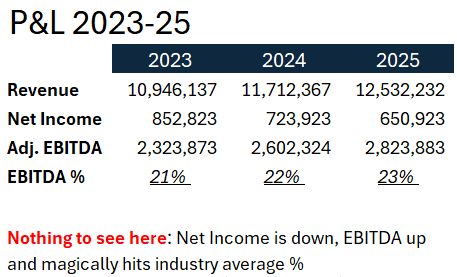
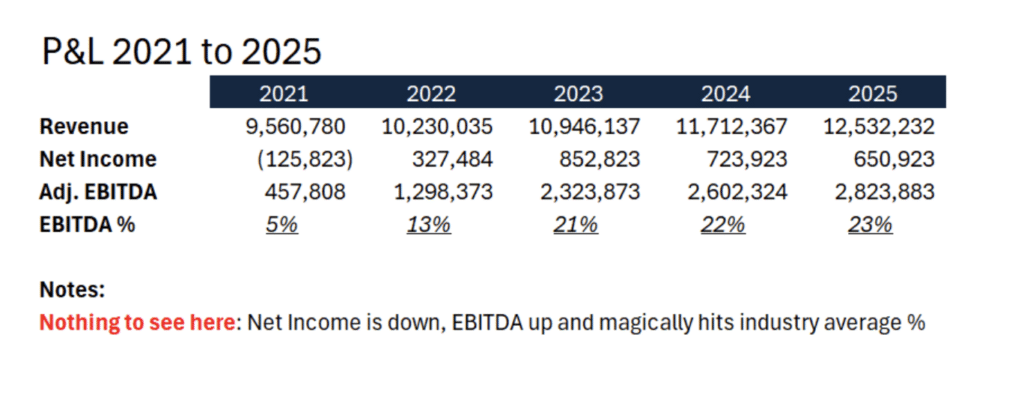
When you play with make believe numbers, it’s possible a few small add-backs might sneak past a buyer, but when it’s death by a thousand cuts taking tax returns reported income of $50k up to $750k adjusted EBITDA, you will see more scrutiny from lenders asking proof to justify every single add-back. Each industry has its own flavor of add-backmaxxing, a few recipes for success (and poor taste) can be found at our success stories blog.
If You Want Your Add-Backs to Hold Up, Focus on Documentation
A buyer’s diligence team asks the same few questions of every add-back: is this truly non-recurring, or does it just feel that way because it’s been a few years? Would the expense actually disappear under new ownership, or does a replacement cost show up somewhere else? And is there evidence, meaning an invoice, a contract, a dated communication, or is this just a story?
Start building that paper trail a year or two before you go to market, not during diligence. Even better, remove all large add-backs, stop using the company as a family slush fund years before you want to sell the business. Business owners can utilize tax code to reduce tax paid over decades, but when it’s time to sell the company, you lose 2X to 5X multiple on these owner related expenses.
If you keep the owner’s expenses running the business, separate your add-backs into two buckets rather than presenting one blended number: the clean items you can fully document, and the gray-area items, like family payroll or mixed-use assets, that require more judgment. Buyers respect a schedule that draws its own conservative lines. It signals a seller dealing in good faith, and that has real value at the table.
Why Aggressive Add-Backs Cost Sellers More Than They Gain
A few things drive this pattern in our experience:
- The trust cascade. One add-back that doesn’t survive scrutiny makes a buyer re-check every other item on the list, and often re-check the seller’s credibility generally.
- The risk discount. Buyers price uncertainty. An aggressive schedule signals more digging ahead, and they discount the offer accordingly before diligence even starts.
- The retrade. A number built on soft add-backs tends to get renegotiated downward mid-process, after both sides have already spent months and legal fees on the deal. This does not just impact pricing multiple, it will impact deal structure, potentially from all cash to large seller’s notes or earn outs.
A smaller, well-supported add-back schedule routinely produces a better effective outcome than an aggressive one, once you account for the discount buyers build in for risk and the odds of a late-stage retrade.
What Actually Moves the Multiple and Produces Better Outcomes

Once earnings are honestly normalized, the multiple applied to them is driven by how concentrated revenue is among a few customers, how dependent the business is on you personally versus a real second layer of management, how recurring the revenue is versus project-based work, the trend over the last three years rather than one good year, and how defensible the financials are on their face. Clean, well-supported financials routinely earn a better multiple than the same raw earnings paired with a fight ahead in diligence, because the buyer is pricing in less risk and less friction. If a buyer can’t make heads of tails of your P&L, Balance Sheet, and normalized Capital Expenditure schedule, forcing them and the lender to just use the tax returns, then the seller should expect this buyer to make a considerably smaller offer with more structure on payment.
Where This Leaves You
The honest version of this exercise isn’t about leaving value on the table. It’s about making sure the value you claim is the value a buyer will actually pay, and that it survives the weeks of diligence between a handshake and a closing wire.
If you are a business seller, buyer, trusted advisor such as a CPA, financial advisor, or attorney, these are the easiest deer in the headlights add-backs:
Top 10 flavors of P&L Add-Backmaxxing
- Full owner salary reversal. Adding back 100% of owner comp with nothing netted out for what a market-rate replacement manager would actually cost.
- Family payroll padding. Relatives on the books with little real function, or paid well above market for the work they do do.
- Personal expenses run through the business. Vehicles, travel, meals, country club dues, home office costs treated as discretionary.
- Recurring “one-time” items. A legal settlement, restructuring cost, or “special project” that mysteriously shows up every year but keeps getting labeled non-recurring.
- Product pricing margin miss. Describing a miss in the market where the company should have increased pricing year on year by 10%, due to inflation, input pricing, demand, etc., but the company kept pricing static and eroded margins.
- Mislabeled growth spend. Marketing, travel, or R&D called “discretionary” when cutting it would actually shrink revenue — a real cost dressed up as a perk.
- Related-party rent games. Below- or above-market rent paid to an owner-owned property entity, normalized in whichever direction favors the seller rather than to true fair market rent.
- Unproven R&D. Money spent on R&D that did not net a return, or has yet to net a return. We see this often in IT business valuations.
- Add-back creep on professional fees. Legal, consulting, or audit fees that recur periodically getting re-labeled non-recurring each time they show up.
- Buyer-specific synergy add-backs. Adding back costs that would only disappear for a specific buyer’s cost structure (shared services, existing back office), not for a normalized standalone operator — the schedule pre-assumes a buyer that doesn’t exist yet.
Now, this top ten could be completely legitimate add-backs, but all require greater scrutiny if they are truly one-time, or in fact regular, routine, and required to operate the business.
Top 10 flavors of Working Capital-maxxing
For capital, equipment, inventory heavy businesses, there can also be all sorts of tom foolery when it comes to working capital and work in progress (WIP). Our least favorite creative WC math includes:
- Cherry-picked peg period. Setting the net working capital target off an unusually low historical month or seasonally light quarter instead of a representative trailing average.
- Pre-close inventory stuffing. Timing purchases or holding inventory artificially high right when the peg-setting snapshot is measured.
- AR/AP timing games around close. Accelerating collections or delaying payables (or the reverse) right before the closing balance sheet is drawn, distorting the true-up.
- Deferred maintenance disguised as leaner working capital. Skipping normal restocking or vendor payments pre-close so cash and payables look artificially light, banking the difference in the true-up.
- Expense-to-capex reclassification. Shifting normal operating spend onto the balance sheet right before the measurement period to make working capital metrics look tighter than they run in reality.
- Excluding stale assets from the definition, not the balance. Carving obsolete inventory or aged AR out of the peg calculation while still counting them as assets on the actual closing balance sheet.
- Prepayment timing manipulation. Pulling in customer deposits or prepayments right before close, then letting them unwind post-close, skewing the snapshot in the seller’s favor.
- Dropping related-party liabilities from the peg. Excluding a payable that was really being funded informally by the owner, inflating the apparent net position.
- Non-representative baseline assumptions. Setting the target off a period of unusual growth or contraction rather than steady-state operations, so the required working capital investment looks smaller (or, from a buyer’s side, larger) than it really is.
- Inconsistent accounting between average and actual. Using different cutoff dates, day-count conventions, or accrual treatment when calculating the historical peg versus the closing statement, manufacturing a favorable variance either way.
If you’re starting to think about your exit, even years out, getting an honest read on your normalized earnings is the natural first step. A great advisor will get down in the weeds within your P&L and Balance Sheet, ask you to document every add-back (however so painful!), trust but verify assumptions, and give you a healthy dose reality check when you need it most.
Interested in a deep dive valuation or help with exit planning? Schedule a conversation with our team and we can walk through what your add-back schedule would look like to a real buyer.
And if you are a professional partner looking to build your knowledge base and community, we always look to work with M&A partners, schedule time with us at anytime.
Common Questions About Add-Backs and Valuation
What is an add-back in a business sale?
An add-back is a personal or non-recurring expense removed from your reported earnings to show what the business would earn under a normal operator. Owner salary above market rate and personal expenses run through the company are common examples.
Can I add back my full salary?
Only the portion above what it would cost to hire a replacement to run the business. The rest reflects a real cost that doesn’t disappear when you leave.
Will a buyer’s diligence team catch inflated add-backs?
In almost every serious deal, yes. A quality of earnings review is standard practice for buyers using debt or investor capital, and it’s built specifically to test add-back schedules against documentation. While not always required on SBA funded transactions, it increasingly is being used by small business buyers, and a requirement by the SBA for specific business sales and loans.
Does a smaller add-back schedule mean a lower price?
Not necessarily, and often the opposite. A conservative, well-documented schedule tends to hold up through diligence rather than getting cut mid-process, which usually produces a better final number than an aggressive one that doesn’t survive.
